How to Read Obd Freeze Frame Data for P0174 on Bmw E46
OBD-2 PIDs (On-board diagnostics Parameter IDs) are codes used to request data from a vehicle, used as a diagnostic tool.
SAE standard J1979 defines many OBD-II PIDs. All on-road vehicles and trucks sold in Northward America are required to support a subset of these codes, primarily for state mandated emissions inspections. Manufacturers likewise define additional PIDs specific to their vehicles. Though not mandated, many motorcycles also support OBD-Ii PIDs.
In 1996, lite duty vehicles (less than 8,500 lb [3,900 kg]) were the kickoff to be mandated followed by medium duty vehicles (betwixt viii,500–fourteen,000 lb [3,900–6,400 kg]) in 2005.[ane] They are both required to exist accessed through a standardized data link connector divers by SAE J1962.
Heavy duty vehicles (greater than 14,000 lb [6,400 kg]) made after 2010,[1] for sale in the US are allowed to support OBD-II diagnostics through SAE standard J1939-13 (a round diagnostic connector) according to CARB in championship 13 CCR 1971.i. Some heavy duty trucks in North America employ the SAE J1962 OBD-II diagnostic connector that is common with passenger cars, notably Mack and Volvo Trucks, however they use 29 bit Can identifiers (unlike 11 bit headers used past passenger cars).
Services / Modes [edit]
There are x diagnostic services described in the latest OBD-Ii standard SAE J1979. Before 2002, J1979 referred to these services as "modes". They are equally follows:
| Service / Style (hex) | Description |
|---|---|
| 01 | Show current data |
| 02 | Show freeze frame data |
| 03 | Show stored Diagnostic Problem Codes |
| 04 | Clear Diagnostic Trouble Codes and stored values |
| 05 | Exam results, oxygen sensor monitoring (not Tin only) |
| 06 | Test results, other component/system monitoring (Test results, oxygen sensor monitoring for CAN only) |
| 07 | Evidence pending Diagnostic Trouble Codes (detected during current or last driving cycle) |
| 08 | Command operation of on-lath component/system |
| 09 | Asking vehicle information |
| 0A | Permanent Diagnostic Trouble Codes (DTCs) (Cleared DTCs) |
Vehicle manufacturers are non required to support all services. Each manufacturer may define additional services in a higher place #nine (due east.k.: service 22 as defined past SAE J2190 for Ford/GM, service 21 for Toyota) for other information e.g. the voltage of the traction battery in a hybrid electric vehicle (HEV).[2]
The nonOBD UDS services start at 0x10 to avoid overlap of ID-range.
Standard PIDs [edit]
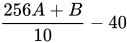
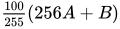
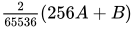
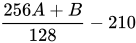
The table below shows the standard OBD-II PIDs as defined by SAE J1979. The expected response for each PID is given, along with data on how to translate the response into meaningful data. Again, non all vehicles will support all PIDs and there tin be manufacturer-defined custom PIDs that are non defined in the OBD-II standard.
Note that services 01 and 02 are basically identical, except that service 01 provides current information, whereas service 02 provides a snapshot of the same data taken at the betoken when the last diagnostic trouble code was set. The exceptions are PID 01, which is only bachelor in service 01, and PID 02, which is only available in service 02. If service 02 PID 02 returns zero, and then there is no snapshot and all other service 02 information is meaningless.
When using Bit-Encoded-Notation, quantities like C4 means scrap four from data byte C. Each fleck is numerated from 0 to 7, so vii is the nearly significant flake and 0 is the to the lowest degree meaning bit (See below).
| A | B | C | D | ||||||||||||||||||||||||||||
| A7 | A6 | A5 | A4 | A3 | A2 | A1 | A0 | B7 | B6 | B5 | B4 | B3 | B2 | B1 | B0 | C7 | C6 | C5 | C4 | C3 | C2 | C1 | C0 | D7 | D6 | D5 | D4 | D3 | D2 | D1 | D0 |
Service 01 - Evidence electric current data [edit]
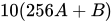
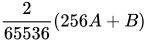
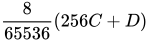
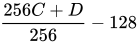
| PIDs (hex) | PID (Dec) | Data bytes returned | Clarification | Min value | Max value | Units | Formula[a] |
|---|---|---|---|---|---|---|---|
| 00 | 0 | 4 | PIDs supported [01 - xx] | Bit encoded [A7..D0] == [PID $01..PID $20] See below | |||
| 01 | i | iv | Monitor status since DTCs cleared. (Includes malfunction indicator lamp (MIL), status and number of DTCs, components tests, DTC readiness checks) | Bit encoded. Meet beneath | |||
| 02 | 2 | 2 | Freeze DTC | ||||
| 03 | 3 | 2 | Fuel system status | Bit encoded. Encounter below | |||
| 04 | 4 | ane | Calculated engine load | 0 | 100 | % | (or ) |
| 05 | 5 | ane | Engine coolant temperature | -40 | 215 | °C | |
| 06 | half dozen | 1 | Short term fuel trim—Bank 1 | -100 (Reduce Fuel: Besides Rich) | 99.ii (Add Fuel: Too Lean) | % |
|
| 07 | seven | 1 | Long term fuel trim—Bank one | ||||
| 08 | 8 | 1 | Curt term fuel trim—Bank 2 | ||||
| 09 | 9 | 1 | Long term fuel trim—Bank 2 | ||||
| 0A | ten | one | Fuel pressure (gauge pressure) | 0 | 765 | kPa | |
| 0B | 11 | ane | Intake manifold absolute pressure | 0 | 255 | kPa | |
| 0C | 12 | ii | Engine speed | 0 | 16,383.75 | rpm | |
| 0D | 13 | ane | Vehicle speed | 0 | 255 | km/h | |
| 0E | 14 | 1 | Timing advance | -64 | 63.5 | ° before TDC | |
| 0F | 15 | 1 | Intake air temperature | -twoscore | 215 | °C | |
| x | 16 | 2 | Mass air flow sensor (MAF) air flow rate | 0 | 655.35 | grams/sec | |
| eleven | 17 | ane | Throttle position | 0 | 100 | % | |
| 12 | eighteen | 1 | Commanded secondary air condition | Bit encoded. See below | |||
| thirteen | 19 | 1 | Oxygen sensors present (in 2 banks) | [A0..A3] == Banking company 1, Sensors 1-iv. [A4..A7] == Bank two... | |||
| fourteen | 20 | 2 | Oxygen Sensor one A: Voltage B: Brusk term fuel trim | 0 -100 | ane.275 99.ii | volts % |
|
| 15 | 21 | ii | Oxygen Sensor 2 A: Voltage B: Short term fuel trim | ||||
| xvi | 22 | two | Oxygen Sensor 3 A: Voltage B: Curt term fuel trim | ||||
| 17 | 23 | 2 | Oxygen Sensor 4 A: Voltage B: Short term fuel trim | ||||
| 18 | 24 | 2 | Oxygen Sensor 5 A: Voltage B: Curt term fuel trim | ||||
| 19 | 25 | 2 | Oxygen Sensor 6 A: Voltage B: Short term fuel trim | ||||
| 1A | 26 | 2 | Oxygen Sensor vii A: Voltage B: Short term fuel trim | ||||
| 1B | 27 | ii | Oxygen Sensor 8 A: Voltage B: Brusk term fuel trim | ||||
| 1C | 28 | i | OBD standards this vehicle conforms to | 1 | 250 | - | enumerated. See beneath |
| 1D | 29 | one | Oxygen sensors present (in 4 banks) | Similar to PID 13, but [A0..A7] == [B1S1, B1S2, B2S1, B2S2, B3S1, B3S2, B4S1, B4S2] | |||
| 1E | thirty | 1 | Auxiliary input status | A0 == Power Have Off (PTO) condition (1 == agile) [A1..A7] not used | |||
| 1F | 31 | 2 | Run time since engine commencement | 0 | 65,535 | seconds | |
| 20 | 32 | 4 | PIDs supported [21 - 40] | Scrap encoded [A7..D0] == [PID $21..PID $twoscore] See below | |||
| 21 | 33 | 2 | Distance traveled with malfunction indicator lamp (MIL) on | 0 | 65,535 | km | |
| 22 | 34 | 2 | Fuel Rails Pressure (relative to manifold vacuum) | 0 | 5177.265 | kPa | |
| 23 | 35 | 2 | Fuel Rail Estimate Pressure (diesel fuel, or gasoline straight injection) | 0 | 655,350 | kPa | |
| 24 | 36 | 4 | Oxygen Sensor 1 AB: Air-Fuel Equivalence Ratio (lambda,λ) CD: Voltage | 0 0 | < 2 < 8 | ratio Five |
|
| 25 | 37 | 4 | Oxygen Sensor 2 AB: Air-Fuel Equivalence Ratio (lambda,λ) CD: Voltage | ||||
| 26 | 38 | four | Oxygen Sensor 3 AB: Air-Fuel Equivalence Ratio (lambda,λ) CD: Voltage | ||||
| 27 | 39 | four | Oxygen Sensor 4 AB: Air-Fuel Equivalence Ratio (lambda,λ) CD: Voltage | ||||
| 28 | 40 | 4 | Oxygen Sensor five AB: Air-Fuel Equivalence Ratio (lambda,λ) CD: Voltage | ||||
| 29 | 41 | iv | Oxygen Sensor half-dozen AB: Air-Fuel Equivalence Ratio (lambda,λ) CD: Voltage | ||||
| 2A | 42 | four | Oxygen Sensor 7 AB: Air-Fuel Equivalence Ratio (lambda,λ) CD: Voltage | ||||
| 2B | 43 | 4 | Oxygen Sensor 8 AB: Air-Fuel Equivalence Ratio (lambda,λ) CD: Voltage | ||||
| 2C | 44 | 1 | Commanded EGR | 0 | 100 | % | |
| 2D | 45 | 1 | EGR Error | -100 | 99.2 | % | |
| 2E | 46 | i | Commanded evaporative purge | 0 | 100 | % | |
| 2F | 47 | 1 | Fuel Tank Level Input | 0 | 100 | % | |
| xxx | 48 | one | Warm-ups since codes cleared | 0 | 255 | count | |
| 31 | 49 | 2 | Distance traveled since codes cleared | 0 | 65,535 | km | |
| 32 | 50 | 2 | Evap. System Vapor Pressure | -eight,192 | 8191.75 | Pa | (AB is two's complement signed)[3] |
| 33 | 51 | 1 | Accented Barometric Pressure | 0 | 255 | kPa | |
| 34 | 52 | 4 | Oxygen Sensor 1 AB: Air-Fuel Equivalence Ratio (lambda,λ) CD: Current | 0 -128 | < 2 <128 | ratio mA |
|
| 35 | 53 | 4 | Oxygen Sensor 2 AB: Air-Fuel Equivalence Ratio (lambda,λ) CD: Electric current | ||||
| 36 | 54 | 4 | Oxygen Sensor 3 AB: Air-Fuel Equivalence Ratio (lambda,λ) CD: Electric current | ||||
| 37 | 55 | 4 | Oxygen Sensor 4 AB: Air-Fuel Equivalence Ratio (lambda,λ) CD: Current | ||||
| 38 | 56 | 4 | Oxygen Sensor 5 AB: Air-Fuel Equivalence Ratio (lambda,λ) CD: Current | ||||
| 39 | 57 | 4 | Oxygen Sensor vi AB: Air-Fuel Equivalence Ratio (lambda,λ) CD: Electric current | ||||
| 3A | 58 | four | Oxygen Sensor 7 AB: Air-Fuel Equivalence Ratio (lambda,λ) CD: Current | ||||
| 3B | 59 | four | Oxygen Sensor 8 AB: Air-Fuel Equivalence Ratio (lambda,λ) CD: Current | ||||
| 3C | 60 | two | Catalyst Temperature: Bank 1, Sensor i | -40 | 6,513.5 | °C | |
| 3D | 61 | 2 | Catalyst Temperature: Bank 2, Sensor 1 | ||||
| 3E | 62 | 2 | Goad Temperature: Bank 1, Sensor 2 | ||||
| 3F | 63 | ii | Goad Temperature: Banking company 2, Sensor 2 | ||||
| xl | 64 | 4 | PIDs supported [41 - threescore] | Scrap encoded [A7..D0] == [PID $41..PID $60] See beneath | |||
| 41 | 65 | 4 | Monitor status this drive cycle | Scrap encoded. Meet below | |||
| 42 | 66 | 2 | Control module voltage | 0 | 65.535 | V | |
| 43 | 67 | 2 | Absolute load value | 0 | 25,700 | % | |
| 44 | 68 | 2 | Commanded Air-Fuel Equivalence Ratio (lambda,λ) | 0 | < 2 | ratio | |
| 45 | 69 | 1 | Relative throttle position | 0 | 100 | % | |
| 46 | lxx | 1 | Ambient air temperature | -xl | 215 | °C | |
| 47 | 71 | 1 | Absolute throttle position B | 0 | 100 | % | |
| 48 | 72 | one | Absolute throttle position C | ||||
| 49 | 73 | 1 | Accelerator pedal position D | ||||
| 4A | 74 | 1 | Accelerator pedal position E | ||||
| 4B | 75 | 1 | Accelerator pedal position F | ||||
| 4C | 76 | 1 | Commanded throttle actuator | ||||
| 4D | 77 | ii | Time run with MIL on | 0 | 65,535 | minutes | |
| 4E | 78 | two | Time since trouble codes cleared | ||||
| 4F | 79 | iv | Maximum value for Fuel–Air equivalence ratio, oxygen sensor voltage, oxygen sensor current, and intake manifold absolute pressure | 0, 0, 0, 0 | 255, 255, 255, 2550 | ratio, 5, mA, kPa | , , , |
| 50 | 80 | 4 | Maximum value for air menstruation rate from mass air flow sensor | 0 | 2550 | g/due south | , , , and are reserved for future use |
| 51 | 81 | 1 | Fuel Type | From fuel type table run across below | |||
| 52 | 82 | 1 | Ethanol fuel % | 0 | 100 | % | |
| 53 | 83 | 2 | Absolute Evap organisation Vapor Pressure | 0 | 327.675 | kPa | |
| 54 | 84 | 2 | Evap system vapor pressure level | -32,768 | 32,767 | Pa | (AB is 2'due south complement signed)[three] |
| 55 | 85 | 2 | Short term secondary oxygen sensor trim, A: depository financial institution 1, B: banking concern 3 | -100 | 99.2 | % |
|
| 56 | 86 | two | Long term secondary oxygen sensor trim, A: banking company 1, B: bank three | ||||
| 57 | 87 | 2 | Brusk term secondary oxygen sensor trim, A: bank ii, B: banking company 4 | ||||
| 58 | 88 | two | Long term secondary oxygen sensor trim, A: banking concern 2, B: bank 4 | ||||
| 59 | 89 | 2 | Fuel rail absolute pressure | 0 | 655,350 | kPa | |
| 5A | xc | 1 | Relative accelerator pedal position | 0 | 100 | % | |
| 5B | 91 | one | Hybrid battery pack remaining life | 0 | 100 | % | |
| 5C | 92 | i | Engine oil temperature | -xl | 210 | °C | |
| 5D | 93 | 2 | Fuel injection timing | -210.00 | 301.992 | ° | |
| 5E | 94 | 2 | Engine fuel charge per unit | 0 | 3212.75 | L/h | |
| 5F | 95 | ane | Emission requirements to which vehicle is designed | Fleck Encoded | |||
| 60 | 96 | 4 | PIDs supported [61 - 80] | Flake encoded [A7..D0] == [PID $61..PID $eighty] Run across below | |||
| 61 | 97 | one | Commuter's need engine - pct torque | -125 | 130 | % | |
| 62 | 98 | 1 | Actual engine - percentage torque | -125 | 130 | % | |
| 63 | 99 | 2 | Engine reference torque | 0 | 65,535 | Nm | |
| 64 | 100 | 5 | Engine percentage torque data | -125 | 130 | % | Idle Engine signal ane Engine betoken two Engine point 3 Engine point 4 |
| 65 | 101 | two | Auxiliary input / output supported | Bit Encoded | |||
| 66 | 102 | 5 | Mass air flow sensor | 0 | 2047.96875 | grams/sec | [A0]== Sensor A Supported [A1]== Sensor B Supported Sensor A: Sensor B: |
| 67 | 103 | 3 | Engine coolant temperature | -xl | 215 | °C | [A0]== Sensor i Supported [A1]== Sensor 2 Supported Sensor i: Sensor 2: |
| 68 | 104 | iii | Intake air temperature sensor | -xl | 215 | °C | [A0]== Sensor 1 Supported [A1]== Sensor ii Supported Sensor 1: Sensor ii: |
| 69 | 105 | seven | Actual EGR, Allowable EGR, and EGR Fault | ||||
| 6A | 106 | 5 | Commanded Diesel intake air flow control and relative intake air flow position | ||||
| 6B | 107 | v | Exhaust gas recirculation temperature | ||||
| 6C | 108 | 5 | Commanded throttle actuator control and relative throttle position | ||||
| 6D | 109 | eleven | Fuel pressure command arrangement | ||||
| 6E | 110 | 9 | Injection force per unit area control system | ||||
| 6F | 111 | 3 | Turbocharger compressor inlet pressure | ||||
| 70 | 112 | 10 | Boost force per unit area command | ||||
| 71 | 113 | 6 | Variable Geometry turbo (VGT) control | ||||
| 72 | 114 | five | Wastegate control | ||||
| 73 | 115 | 5 | Exhaust pressure | ||||
| 74 | 116 | 5 | Turbocharger RPM | ||||
| 75 | 117 | 7 | Turbocharger temperature | ||||
| 76 | 118 | vii | Turbocharger temperature | ||||
| 77 | 119 | 5 | Accuse air cooler temperature (CACT) | ||||
| 78 | 120 | nine | Frazzle Gas temperature (EGT) Bank 1 | Special PID. Meet beneath | |||
| 79 | 121 | 9 | Frazzle Gas temperature (EGT) Banking concern 2 | Special PID. See below | |||
| 7A | 122 | 7 | Diesel particulate filter (DPF) differential pressure | ||||
| 7B | 123 | 7 | Diesel particulate filter (DPF) | ||||
| 7C | 124 | ix | Diesel fuel Particulate filter (DPF) temperature | °C | |||
| 7D | 125 | 1 | NOx NTE (Non-To-Exceed) command area status | ||||
| 7E | 126 | 1 | PM NTE (Not-To-Exceed) control area status | ||||
| 7F | 127 | 13 | Engine run time [b] | seconds | |||
| eighty | 128 | four | PIDs supported [81 - A0] | Scrap encoded [A7..D0] == [PID $81..PID $A0] See below | |||
| 81 | 129 | 41 | Engine run fourth dimension for Auxiliary Emissions Command Device(AECD) | ||||
| 82 | 130 | 41 | Engine run fourth dimension for Auxiliary Emissions Control Device(AECD) | ||||
| 83 | 131 | 9 | NOx sensor | ||||
| 84 | 132 | i | Manifold surface temperature | ||||
| 85 | 133 | 10 | NOx reagent system | ||||
| 86 | 134 | 5 | Particulate matter (PM) sensor | ||||
| 87 | 135 | 5 | Intake manifold absolute pressure | ||||
| 88 | 136 | 13 | SCR Induce System | ||||
| 89 | 137 | 41 | Run Time for AECD #11-#15 | ||||
| 8A | 138 | 41 | Run Time for AECD #16-#20 | ||||
| 8B | 139 | 7 | Diesel Aftertreatment | ||||
| 8C | 140 | 17 | O2 Sensor (Wide Range) | ||||
| 8D | 141 | ane | Throttle Position 1000 | 0 | 100 | % | |
| 8E | 142 | 1 | Engine Friction - Percentage Torque | -125 | 130 | % | |
| 8F | 143 | 7 | PM Sensor Bank one & 2 | ||||
| 90 | 144 | 3 | WWH-OBD Vehicle OBD System Information | hours | |||
| 91 | 145 | 5 | WWH-OBD Vehicle OBD System Information | hours | |||
| 92 | 146 | ii | Fuel System Control | ||||
| 93 | 147 | 3 | WWH-OBD Vehicle OBD Counters support | hours | |||
| 94 | 148 | 12 | NOx Alarm And Inducement System | ||||
| 98 | 152 | nine | Exhaust Gas Temperature Sensor | ||||
| 99 | 153 | 9 | Exhaust Gas Temperature Sensor | ||||
| 9A | 154 | 6 | Hybrid/EV Vehicle System Information, Battery, Voltage | ||||
| 9B | 155 | 4 | Diesel Exhaust Fluid Sensor Information | ||||
| 9C | 156 | 17 | O2 Sensor Data | ||||
| 9D | 157 | 4 | Engine Fuel Charge per unit | g/s | |||
| 9E | 158 | 2 | Engine Exhaust Flow Rate | kg/h | |||
| 9F | 159 | nine | Fuel Organisation Percentage Use | ||||
| A0 | 160 | iv | PIDs supported [A1 - C0] | Flake encoded [A7..D0] == [PID $A1..PID $C0] See below | |||
| A1 | 161 | nine | NOx Sensor Corrected Data | ppm | |||
| A2 | 162 | 2 | Cylinder Fuel Rate | 0 | 2047.96875 | mg/stroke | |
| A3 | 163 | 9 | Evap System Vapor Force per unit area | Pa | |||
| A4 | 164 | 4 | Transmission Actual Gear | 0 | 65.535 | ratio | [A1]==Supported
|
| A5 | 165 | 4 | Commanded Diesel Exhaust Fluid Dosing | 0 | 127.5 | % | [A0]= one:Supported; 0:Unsupported
|
| A6 | 166 | four | Odometer [c] | 0 | 429,496,729.5 | km | |
| A7 | 167 | 4 | NOx Sensor Concentration Sensors 3 and four | ||||
| A8 | 168 | iv | NOx Sensor Corrected Concentration Sensors 3 and four | ||||
| A9 | 169 | 4 | ABS Disable Switch State | [A0]= i:Supported; 0:Unsupported [B0]= one:Yes;0:No | |||
| C0 | 192 | four | PIDs supported [C1 - E0] | 0x0 | 0xffffffff | Chip encoded [A7..D0] == [PID $C1..PID $E0] See below | |
| C3 | 195 | ? | ? | ? | ? | ? | Returns numerous information, including Drive Status ID and Engine Speed* |
| C4 | 196 | ? | ? | ? | ? | ? | B5 is Engine Idle Asking B6 is Engine Finish Asking* |
| PID (hex) | PID (Dec) | Data bytes returned | Description | Min value | Max value | Units | Formula[a] |










Service 02 - Show freeze frame data [edit]
Service 02 accepts the same PIDs as service 01, with the same meaning,[5] only data given is from when the freeze frame[6] was created.
You have to ship the frame number in the data section of the message.
| PID (hex) | Data bytes returned | Description | Min value | Max value | Units | Formula[a] |
|---|---|---|---|---|---|---|
| 02 | 2 | DTC that caused freeze frame to be stored. | BCD encoded. Decoded equally in service three |
Service 03 - Show stored Diagnostic Trouble Codes (DTCs) [edit]
| PID (hex) | Information bytes returned | Description | Min value | Max value | Units | Formula[a] |
|---|---|---|---|---|---|---|
| N/A | n*vi | Request trouble codes | 3 codes per message frame. Encounter below |
Service 04 - Clear Diagnostic Trouble Codes and stored values [edit]
| PID (hex) | Data bytes returned | Description | Min value | Max value | Units | Formula[a] |
|---|---|---|---|---|---|---|
| N/A | 0 | Clear trouble codes / Malfunction indicator lamp (MIL) / Cheque engine calorie-free | Clears all stored trouble codes and turns the MIL off. |
Service 05 - Test results, oxygen sensor monitoring (non CAN just) [edit]
| PID (hex) | Data bytes returned | Description | Min value | Max value | Units | Formula[a] |
|---|---|---|---|---|---|---|
| 0100 | iv | OBD Monitor IDs supported ($01 – $xx) | 0x0 | 0xffffffff | ||
| 0101 | two | O2 Sensor Monitor Bank 1 Sensor 1 | 0.00 | one.275 | volts | 0.005 Rich to lean sensor threshold voltage |
| 0102 | O2 Sensor Monitor Bank 1 Sensor two | 0.00 | ane.275 | volts | 0.005 Rich to lean sensor threshold voltage | |
| 0103 | O2 Sensor Monitor Bank 1 Sensor 3 | 0.00 | 1.275 | volts | 0.005 Rich to lean sensor threshold voltage | |
| 0104 | O2 Sensor Monitor Banking concern ane Sensor 4 | 0.00 | 1.275 | volts | 0.005 Rich to lean sensor threshold voltage | |
| 0105 | O2 Sensor Monitor Depository financial institution 2 Sensor 1 | 0.00 | 1.275 | volts | 0.005 Rich to lean sensor threshold voltage | |
| 0106 | O2 Sensor Monitor Bank ii Sensor two | 0.00 | 1.275 | volts | 0.005 Rich to lean sensor threshold voltage | |
| 0107 | O2 Sensor Monitor Bank 2 Sensor 3 | 0.00 | ane.275 | volts | 0.005 Rich to lean sensor threshold voltage | |
| 0108 | O2 Sensor Monitor Bank 2 Sensor 4 | 0.00 | 1.275 | volts | 0.005 Rich to lean sensor threshold voltage | |
| 0109 | O2 Sensor Monitor Bank 3 Sensor 1 | 0.00 | 1.275 | volts | 0.005 Rich to lean sensor threshold voltage | |
| 010A | O2 Sensor Monitor Bank 3 Sensor ii | 0.00 | 1.275 | volts | 0.005 Rich to lean sensor threshold voltage | |
| 010B | O2 Sensor Monitor Bank 3 Sensor three | 0.00 | 1.275 | volts | 0.005 Rich to lean sensor threshold voltage | |
| 010C | O2 Sensor Monitor Bank three Sensor four | 0.00 | 1.275 | volts | 0.005 Rich to lean sensor threshold voltage | |
| 010D | O2 Sensor Monitor Banking concern 4 Sensor 1 | 0.00 | 1.275 | volts | 0.005 Rich to lean sensor threshold voltage | |
| 010E | O2 Sensor Monitor Bank 4 Sensor ii | 0.00 | 1.275 | volts | 0.005 Rich to lean sensor threshold voltage | |
| 010F | O2 Sensor Monitor Bank iv Sensor 3 | 0.00 | 1.275 | volts | 0.005 Rich to lean sensor threshold voltage | |
| 0110 | O2 Sensor Monitor Bank four Sensor four | 0.00 | ane.275 | volts | 0.005 Rich to lean sensor threshold voltage | |
| 0201 | O2 Sensor Monitor Depository financial institution i Sensor 1 | 0.00 | 1.275 | volts | 0.005 Lean to Rich sensor threshold voltage | |
| 0202 | O2 Sensor Monitor Bank one Sensor 2 | 0.00 | i.275 | volts | 0.005 Lean to Rich sensor threshold voltage | |
| 0203 | O2 Sensor Monitor Bank 1 Sensor three | 0.00 | 1.275 | volts | 0.005 Lean to Rich sensor threshold voltage | |
| 0204 | O2 Sensor Monitor Banking company 1 Sensor iv | 0.00 | i.275 | volts | 0.005 Lean to Rich sensor threshold voltage | |
| 0205 | O2 Sensor Monitor Bank two Sensor ane | 0.00 | one.275 | volts | 0.005 Lean to Rich sensor threshold voltage | |
| 0206 | O2 Sensor Monitor Bank ii Sensor 2 | 0.00 | 1.275 | volts | 0.005 Lean to Rich sensor threshold voltage | |
| 0207 | O2 Sensor Monitor Bank 2 Sensor 3 | 0.00 | 1.275 | volts | 0.005 Lean to Rich sensor threshold voltage | |
| 0208 | O2 Sensor Monitor Depository financial institution 2 Sensor iv | 0.00 | ane.275 | volts | 0.005 Lean to Rich sensor threshold voltage | |
| 0209 | O2 Sensor Monitor Bank 3 Sensor 1 | 0.00 | one.275 | volts | 0.005 Lean to Rich sensor threshold voltage | |
| 020A | O2 Sensor Monitor Bank iii Sensor 2 | 0.00 | 1.275 | volts | 0.005 Lean to Rich sensor threshold voltage | |
| 020B | O2 Sensor Monitor Bank three Sensor 3 | 0.00 | 1.275 | volts | 0.005 Lean to Rich sensor threshold voltage | |
| 020C | O2 Sensor Monitor Banking company 3 Sensor 4 | 0.00 | i.275 | volts | 0.005 Lean to Rich sensor threshold voltage | |
| 020D | O2 Sensor Monitor Bank 4 Sensor 1 | 0.00 | 1.275 | volts | 0.005 Lean to Rich sensor threshold voltage | |
| 020E | O2 Sensor Monitor Bank iv Sensor two | 0.00 | 1.275 | volts | 0.005 Lean to Rich sensor threshold voltage | |
| 020F | O2 Sensor Monitor Depository financial institution 4 Sensor iii | 0.00 | 1.275 | volts | 0.005 Lean to Rich sensor threshold voltage | |
| 0210 | O2 Sensor Monitor Banking company iv Sensor 4 | 0.00 | 1.275 | volts | 0.005 Lean to Rich sensor threshold voltage | |
| PID (hex) | Data bytes returned | Description | Min value | Max value | Units | Formula[a] |
Service 09 - Request vehicle information [edit]
| PID (hex) | Data bytes returned | Description | Min value | Max value | Units | Formula[a] |
|---|---|---|---|---|---|---|
| 00 | four | Service 9 supported PIDs (01 to twenty) | Bit encoded. [A7..D0] = [PID $01..PID $20] Meet below | |||
| 01 | 1 | VIN Message Count in PID 02. Merely for ISO 9141-2, ISO 14230-iv and SAE J1850. | Usually the value will be 5. | |||
| 02 | 17 | Vehicle Identification Number (VIN) | 17-char VIN, ASCII-encoded and left-padded with cypher chars (0x00) if needed to. | |||
| 03 | 1 | Calibration ID message count for PID 04. Only for ISO 9141-2, ISO 14230-4 and SAE J1850. | It will be a multiple of four (4 messages are needed for each ID). | |||
| 04 | 16,32,48,64.. | Calibration ID | Upwards to 16 ASCII chars. Data bytes non used volition be reported every bit aught bytes (0x00). Several CALID can be outputed (xvi bytes each) | |||
| 05 | 1 | Scale verification numbers (CVN) bulletin count for PID 06. Simply for ISO 9141-2, ISO 14230-four and SAE J1850. | ||||
| 06 | 4,8,12,16 | Calibration Verification Numbers (CVN) Several CVN can be output (4 bytes each) the number of CVN and CALID must match | Raw data left-padded with null characters (0x00). Usually displayed as hex string. | |||
| 07 | one | In-use performance tracking message count for PID 08 and 0B. Merely for ISO 9141-2, ISO 14230-4 and SAE J1850. | viii | 10 | 8 if xvi values are required to exist reported, 9 if 18 values are required to be reported, and 10 if twenty values are required to be reported (1 message reports two values, each one consisting in two bytes). | |
| 08 | four | In-utilize performance tracking for spark ignition vehicles | 4 or 5 messages, each one containing 4 bytes (two values). See beneath | |||
| 09 | 1 | ECU name message count for PID 0A | ||||
| 0A | 20 | ECU proper noun | ASCII-coded. Right-padded with goose egg chars (0x00). | |||
| 0B | four | In-use operation tracking for compression ignition vehicles | 5 messages, each one containing iv bytes (2 values). Encounter below | |||
| PID (hex) | Data bytes returned | Clarification | Min value | Max value | Units | Formula[a] |
- ^ a b c d e f g h i In the formula column, letters A, B, C, etc. represent the first, second, third, etc. byte of the data. For example, for two data bytes
0F 19,A = 0FandB = 19. Where a (?) appears, contradictory or incomplete information was bachelor. - ^ Starting with MY 2010 the California Air Resource Board mandated that all diesel vehicles must supply total engine hours [4]
- ^ Starting with MY 2019 the California Air Resources Board mandated that all vehicles must supply odometer[4]
Bitwise encoded PIDs [edit]
Some of the PIDs in the to a higher place table cannot exist explained with a simple formula. A more elaborate explanation of these data is provided here:
Service 01 PID 00 - Prove PIDs supported [edit]
A request for this PID returns 4 bytes of data (Big-endian). Each scrap, from MSB to LSB, represents one of the next 32 PIDs and specifies whether that PID is supported.
For instance, if the car response is BE1FA813, it tin be decoded like this:
| Hexadecimal | B | E | ane | F | A | viii | 1 | 3 | ||||||||||||||||||||||||
|---|---|---|---|---|---|---|---|---|---|---|---|---|---|---|---|---|---|---|---|---|---|---|---|---|---|---|---|---|---|---|---|---|
| Binary | 1 | 0 | 1 | 1 | 1 | 1 | 1 | 0 | 0 | 0 | 0 | 1 | ane | 1 | 1 | ane | 1 | 0 | 1 | 0 | 1 | 0 | 0 | 0 | 0 | 0 | 0 | ane | 0 | 0 | 1 | 1 |
| Supported? | Aye | No | Aye | Aye | Yes | Yeah | Yeah | No | No | No | No | Yes | Aye | Aye | Yes | Yes | Yes | No | Yes | No | Yes | No | No | No | No | No | No | Yeah | No | No | Yes | Yeah |
| PID number | 01 | 02 | 03 | 04 | 05 | 06 | 07 | 08 | 09 | 0A | 0B | 0C | 0D | 0E | 0F | ten | 11 | 12 | 13 | xiv | 15 | 16 | 17 | xviii | nineteen | 1A | 1B | 1C | 1D | 1E | 1F | 20 |
And then, supported PIDs are: 01, 03, 04, 05, 06, 07, 0C, 0D, 0E, 0F, 10, 11, 13, fifteen, 1C, 1F and 20
Service 01 PID 01 - Monitor status since DTCs cleared [edit]
A request for this PID returns 4 bytes of data, labeled A B C and D.
The first byte(A) contains ii pieces of information. Bit A7 (MSB of byte A, the first byte) indicates whether or not the MIL (check engine light) is illuminated. Bits A6 through A0 represent the number of diagnostic trouble codes currently flagged in the ECU.
The 2d, 3rd, and 4th bytes(B, C and D) give information about the availability and completeness of certain on-lath tests ("OBD readiness checks"). Notation that test availability is indicated by set (1) bit and completeness is indicated past reset (0) fleck.
| Bit | Name | Definition |
|---|---|---|
| A7 | MIL | Off or On, indicates if the CEL/MIL is on (or should be on) |
| A6-A0 | DTC_CNT | Number of confirmed emissions-related DTCs available for brandish. |
| B7 | RESERVED | Reserved (should exist 0) |
| B3 | NO Proper name | 0 = Spark ignition monitors supported (e.thousand. Otto or Wankel engines) 1 = Compression ignition monitors supported (e.g. Diesel engines) |
Hither are the common bit B definitions, they are test based.
| Test available | Test incomplete | |
|---|---|---|
| Components | B2 | B6 |
| Fuel System | B1 | B5 |
| Misfire | B0 | B4 |
The third and quaternary bytes are to be interpreted differently depending on if the engine is spark ignition (e.g. Otto or Wankel engines) or compression ignition (eastward.grand. Diesel engines). In the 2nd (B) byte, bit 3 indicates how to interpret the C and D bytes, with 0 being spark (Otto or Wankel) and 1 (set) being compression (Diesel).
The bytes C and D for spark ignition monitors (due east.g. Otto or Wankel engines):
| Examination available | Exam incomplete | |
|---|---|---|
| EGR and/or VVT System | C7 | D7 |
| Oxygen Sensor Heater | C6 | D6 |
| Oxygen Sensor | C5 | D5 |
| A/C Refrigerant | C4 | D4 |
| Secondary Air Organisation | C3 | D3 |
| Evaporative Organization | C2 | D2 |
| Heated Catalyst | C1 | D1 |
| Catalyst | C0 | D0 |
And the bytes C and D for compression ignition monitors (Diesel fuel engines):
| Test bachelor | Examination incomplete | |
|---|---|---|
| EGR and/or VVT Arrangement | C7 | D7 |
| PM filter monitoring | C6 | D6 |
| Exhaust Gas Sensor | C5 | D5 |
| - Reserved - | C4 | D4 |
| Boost Pressure | C3 | D3 |
| - Reserved - | C2 | D2 |
| NOx/SCR Monitor | C1 | D1 |
| NMHC Catalyst[a] | C0 | D0 |
- ^ NMHC may stand up for Non-Methane HydroCarbons, but J1979 does not enlighten the states. The translation would be the ammonia sensor in the SCR catalyst.
Service 01 PID 41 - Monitor status this drive wheel [edit]
A request for this PID returns 4 bytes of data. The first byte is always zero. The 2nd, third, and fourth bytes give data about the availability and completeness of certain on-board tests. As with PID 01, the third and fourth bytes are to be interpreted differently depending on the ignition blazon (B3) – with 0 existence spark and 1 (set) being compression. Note again that test availability is represented by a set (ane) bit and completeness is represented by a reset (0) fleck.
Here are the common bit B definitions, they are examination based.
| Test available | Examination incomplete | |
|---|---|---|
| Components | B2 | B6 |
| Fuel Arrangement | B1 | B5 |
| Misfire | B0 | B4 |
The bytes C and D for spark ignition monitors (e.g. Otto or Wankel engines):
| Test available | Test incomplete | |
|---|---|---|
| EGR and/or VVT Arrangement | C7 | D7 |
| Oxygen Sensor Heater | C6 | D6 |
| Oxygen Sensor | C5 | D5 |
| A/C Refrigerant | C4 | D4 |
| Secondary Air System | C3 | D3 |
| Evaporative System | C2 | D2 |
| Heated Catalyst | C1 | D1 |
| Catalyst | C0 | D0 |
And the bytes C and D for compression ignition monitors (Diesel engines):
| Test available | Examination incomplete | |
|---|---|---|
| EGR and/or VVT Organisation | C7 | D7 |
| PM filter monitoring | C6 | D6 |
| Frazzle Gas Sensor | C5 | D5 |
| - Reserved - | C4 | D4 |
| Boost Pressure | C3 | D3 |
| - Reserved - | C2 | D2 |
| NOx/SCR Monitor | C1 | D1 |
| NMHC Catalyst[a] | C0 | D0 |
- ^ NMHC may stand for Non-Methyl hydride HydroCarbons, but J1979 does not enlighten usa. The translation would be the ammonia sensor in the SCR goad.
Service 01 PID 78 and 79 - Frazzle Gas temperature (EGT) Depository financial institution 1 and Bank ii [edit]
A asking for this PID will render 9 bytes of data. The first byte is a bit encoded field indicating which EGT sensors are supported:
| Byte | Description |
|---|---|
| A | Supported EGT sensors |
| B-C | Temperature read by EGT11 |
| D-Due east | Temperature read by EGT12 |
| F-Thou | Temperature read by EGT13 |
| H-I | Temperature read by EGT14 |
The first byte is scrap-encoded as follows:
| Bit | Description |
|---|---|
| A7-A4 | Reserved |
| A3 | EGT banking company 1, sensor four Supported? |
| A2 | EGT bank 1, sensor iii Supported? |
| A1 | EGT bank ane, sensor 2 Supported? |
| A0 | EGT bank ane, sensor ane Supported? |
The remaining bytes are xvi bit integers indicating the temperature in degrees Celsius in the range -40 to 6513.5 (scale 0.i), using the usual formula (MSB is A, LSB is B). Only values for which the corresponding sensor is supported are meaningful.

The same construction applies to PID 79, but values are for sensors of bank 2.
Service 03 (no PID required) - Show stored Diagnostic Trouble Codes [edit]
A request for this service returns a list of the DTCs that have been set. The list is encapsulated using the ISO 15765-2 protocol.
If in that location are two or fewer DTCs (4 bytes) they are returned in an ISO-TP Single Frame (SF). Three or more DTCs in the list are reported in multiple frames, with the verbal count of frames dependent on the advice type and addressing details.
Each trouble lawmaking requires ii bytes to describe. The 5-graphic symbol lawmaking of a problem code (like "U0158") may be decoded equally follows from bits. The first character in the problem code is determined by the beginning two $.25 in the first byte:
| A7-A6 | Beginning DTC character |
|---|---|
| 00 | P - Powertrain |
| 01 | C - Chassis |
| 10 | B - Body |
| 11 | U - Network |
The 2 following digits are encoded as two $.25. The second character in the DTC is a number defined by the following table:
| A5-A4 | Second DTC character |
|---|---|
| 00 | 0 |
| 01 | 1 |
| x | two |
| 11 | iii |
The third character in the DTC is a number defined by
| A3-A0 | Third DTC graphic symbol |
|---|---|
| 0000 | 0 |
| 0001 | i |
| 0010 | 2 |
| 0011 | 3 |
| 0100 | iv |
| 0101 | v |
| 0110 | six |
| 0111 | 7 |
| yard | eight |
| 1001 | 9 |
| 1010 | A |
| 1011 | B |
| 1100 | C |
| 1101 | D |
| 1110 | E |
| 1111 | F |
The quaternary and fifth characters are defined in the same way as the third, but using $.25 B7-B4 and B3-B0. The resulting five-character code should look something like "U0158" and tin exist looked up in a table of OBD-2 DTCs to go an actual DTC text. Hexadecimal characters (0-9, A-F), while relatively rare, are allowed in the terminal 3 positions of the code itself.
Service 09 PID 08 - In-use functioning tracking for spark ignition engines [edit]
It provides information virtually runway in-utilise operation for catalyst banks, oxygen sensor banks, evaporative leak detection systems, EGR systems and secondary air organization.
The numerator for each component or system tracks the number of times that all weather condition necessary for a specific monitor to detect a malfunction take been encountered. The denominator for each component or system tracks the number of times that the vehicle has been operated in the specified conditions.
The count of data items should be reported at the get-go (the kickoff byte).
All data items of the In-utilize Performance Tracking record consist of two bytes and are reported in this lodge (each message contains two items, hence the message length is 4).
| Mnemonic | Description |
|---|---|
| OBDCOND | OBD Monitoring Conditions Encountered Counts |
| IGNCNTR | Ignition Counter |
| CATCOMP1 | Catalyst Monitor Completion Counts Depository financial institution 1 |
| CATCOND1 | Catalyst Monitor Conditions Encountered Counts Depository financial institution i |
| CATCOMP2 | Catalyst Monitor Completion Counts Depository financial institution 2 |
| CATCOND2 | Catalyst Monitor Conditions Encountered Counts Depository financial institution 2 |
| O2SCOMP1 | O2 Sensor Monitor Completion Counts Bank 1 |
| O2SCOND1 | O2 Sensor Monitor Conditions Encountered Counts Bank i |
| O2SCOMP2 | O2 Sensor Monitor Completion Counts Bank ii |
| O2SCOND2 | O2 Sensor Monitor Conditions Encountered Counts Bank 2 |
| EGRCOMP | EGR Monitor Completion Condition Counts |
| EGRCOND | EGR Monitor Conditions Encountered Counts |
| AIRCOMP | AIR Monitor Completion Condition Counts (Secondary Air) |
| AIRCOND | AIR Monitor Weather condition Encountered Counts (Secondary Air) |
| EVAPCOMP | EVAP Monitor Completion Condition Counts |
| EVAPCOND | EVAP Monitor Weather condition Encountered Counts |
| SO2SCOMP1 | Secondary O2 Sensor Monitor Completion Counts Bank one |
| SO2SCOND1 | Secondary O2 Sensor Monitor Weather Encountered Counts Bank 1 |
| SO2SCOMP2 | Secondary O2 Sensor Monitor Completion Counts Bank 2 |
| SO2SCOND2 | Secondary O2 Sensor Monitor Conditions Encountered Counts Depository financial institution 2 |
Service 09 PID 0B - In-use functioning tracking for compression ignition engines [edit]
Information technology provides information about runway in-use operation for NMHC goad, NOx goad monitor, NOx adsorber monitor, PM filter monitor, frazzle gas sensor monitor, EGR/ VVT monitor, boost pressure monitor and fuel system monitor.
All information items consist of ii bytes and are reported in this order (each message contains ii items, hence message length is four):
| Mnemonic | Description |
|---|---|
| OBDCOND | OBD Monitoring Conditions Encountered Counts |
| IGNCNTR | Ignition Counter |
| HCCATCOMP | NMHC Catalyst Monitor Completion Condition Counts |
| HCCATCOND | NMHC Catalyst Monitor Atmospheric condition Encountered Counts |
| NCATCOMP | NOx/SCR Catalyst Monitor Completion Condition Counts |
| NCATCOND | NOx/SCR Catalyst Monitor Weather Encountered Counts |
| NADSCOMP | NOx Adsorber Monitor Completion Status Counts |
| NADSCOND | NOx Adsorber Monitor Conditions Encountered Counts |
| PMCOMP | PM Filter Monitor Completion Condition Counts |
| PMCOND | PM Filter Monitor Weather Encountered Counts |
| EGSCOMP | Exhaust Gas Sensor Monitor Completion Condition Counts |
| EGSCOND | Frazzle Gas Sensor Monitor Conditions Encountered Counts |
| EGRCOMP | EGR and/or VVT Monitor Completion Condition Counts |
| EGRCOND | EGR and/or VVT Monitor Conditions Encountered Counts |
| BPCOMP | Heave Pressure level Monitor Completion Status Counts |
| BPCOND | Boost Pressure Monitor Conditions Encountered Counts |
| FUELCOMP | Fuel Monitor Completion Condition Counts |
| FUELCOND | Fuel Monitor Atmospheric condition Encountered Counts |
Enumerated PIDs [edit]
Some PIDs are to exist interpreted specially, and aren't necessarily exactly bitwise encoded, or in any scale. The values for these PIDs are enumerated.
Service 01 PID 03 - Fuel system condition [edit]
A asking for this PID returns 2 bytes of data. The first byte describes fuel system #1.
| Value | Description |
|---|---|
| 0 | The motor is off |
| 1 | Open up loop due to insufficient engine temperature |
| 2 | Closed loop, using oxygen sensor feedback to make up one's mind fuel mix |
| 4 | Open loop due to engine load OR fuel cut due to deceleration |
| 8 | Open up loop due to organization failure |
| 16 | Closed loop, using at least one oxygen sensor only there is a fault in the feedback system |
Any other value is an invalid response.
The 2d byte describes fuel system #2 (if it exists) and is encoded identically to the first byte.
Service 01 PID 12 - Commanded secondary air status [edit]
A request for this PID returns a single byte of data which describes the secondary air status.
| Value | Description |
|---|---|
| ane | Upstream |
| two | Downstream of catalytic converter |
| iv | From the outside temper or off |
| 8 | Pump allowable on for diagnostics |
Any other value is an invalid response.
Service 01 PID 1C - OBD standards this vehicle conforms to [edit]
A request for this PID returns a unmarried byte of information which describes which OBD standards this ECU was designed to comply with. The different values the data byte tin hold are shown below, next to what they hateful:
| Value | Clarification |
|---|---|
| 1 | OBD-II as defined by the CARB |
| two | OBD equally defined past the EPA |
| 3 | OBD and OBD-II |
| four | OBD-I |
| 5 | Not OBD compliant |
| half dozen | EOBD (Europe) |
| 7 | EOBD and OBD-II |
| eight | EOBD and OBD |
| nine | EOBD, OBD and OBD II |
| x | JOBD (Japan) |
| 11 | JOBD and OBD 2 |
| 12 | JOBD and EOBD |
| xiii | JOBD, EOBD, and OBD Ii |
| 14 | Reserved |
| fifteen | Reserved |
| xvi | Reserved |
| 17 | Engine Manufacturer Diagnostics (EMD) |
| 18 | Engine Manufacturer Diagnostics Enhanced (EMD+) |
| xix | Heavy Duty On-Board Diagnostics (Child/Partial) (Hard disk drive OBD-C) |
| 20 | Heavy Duty On-Board Diagnostics (Hd OBD) |
| 21 | World Wide Harmonized OBD (WWH OBD) |
| 22 | Reserved |
| 23 | Heavy Duty Euro OBD Stage I without NOx control (HD EOBD-I) |
| 24 | Heavy Duty Euro OBD Stage I with NOx control (Hard disk EOBD-I Due north) |
| 25 | Heavy Duty Euro OBD Phase 2 without NOx control (Hard disk EOBD-II) |
| 26 | Heavy Duty Euro OBD Phase II with NOx command (Hard disk EOBD-Two Northward) |
| 27 | Reserved |
| 28 | Brazil OBD Stage 1 (OBDBr-1) |
| 29 | Brazil OBD Phase 2 (OBDBr-2) |
| 30 | Korean OBD (KOBD) |
| 31 | India OBD I (IOBD I) |
| 32 | Bharat OBD Two (IOBD Ii) |
| 33 | Heavy Duty Euro OBD Stage VI (Hard disk drive EOBD-IV) |
| 34-250 | Reserved |
| 251-255 | Non available for assignment (SAE J1939 special meaning) |
Service 01 PID 51 - Fuel Type Coding [edit]
Service 01 PID 51 returns a value from an enumerated list giving the fuel type of the vehicle. The fuel type is returned as a unmarried byte, and the value is given past the following table:
| Value | Description |
|---|---|
| 0 | Not available |
| 1 | Gasoline |
| 2 | Methanol |
| iii | Ethanol |
| 4 | Diesel fuel |
| five | LPG |
| 6 | CNG |
| vii | Propane |
| 8 | Electric |
| 9 | Bifuel running Gasoline |
| 10 | Bifuel running Methanol |
| 11 | Bifuel running Ethanol |
| 12 | Bifuel running LPG |
| 13 | Bifuel running CNG |
| 14 | Bifuel running Propane |
| 15 | Bifuel running Electricity |
| 16 | Bifuel running electric and combustion engine |
| 17 | Hybrid gasoline |
| 18 | Hybrid Ethanol |
| 19 | Hybrid Diesel fuel |
| 20 | Hybrid Electric |
| 21 | Hybrid running electrical and combustion engine |
| 22 | Hybrid Regenerative |
| 23 | Bifuel running diesel fuel |
Any other value is reserved by ISO/SAE. There are currently no definitions for flexible-fuel vehicle.
Not-standard PIDs [edit]
The majority of all OBD-2 PIDs in use are non-standard. For most modern vehicles, there are many more functions supported on the OBD-Two interface than are covered by the standard PIDs, and there is relatively small overlap between vehicle manufacturers for these non-standard PIDs.
There is very express data bachelor in the public domain for non-standard PIDs. The master source of data on non-standard PIDs across dissimilar manufacturers is maintained by the Usa-based Equipment and Tool Institute and only bachelor to members. The cost of ETI membership for admission to scan codes varies based on visitor size defined by annual sales of automotive tools and equipment in N America:
| Almanac Sales in North America | Annual Dues |
|---|---|
| Under $x,000,000 | $v,000 |
| $10,000,000 - $50,000,000 | $7,500 |
| Greater than $50,000,000 | $10,000 |
However, even ETI membership will not provide total documentation for not-standard PIDs. ETI state:[seven] [8]
Some OEMs refuse to use ETI as a one-stop source of scan tool information. They prefer to do business organization with each tool company separately. These companies also require that yous enter into a contract with them. The charges vary but here is a snapshot as of Apr 13th, 2015 of the per year charges:
GM $50,000 Honda $v,000 Suzuki $ane,000 BMW $25,500 plus $two,000 per update. Updates occur annually.
CAN (eleven-bit) motorbus format [edit]
The PID query and response occurs on the vehicle'due south Tin can bus. Standard OBD requests and responses use functional addresses. The diagnostic reader initiates a query using Tin can ID 7DFh[ clarification needed ], which acts equally a broadcast address, and accepts responses from whatsoever ID in the range 7E8h to 7EFh. ECUs that tin respond to OBD queries heed both to the functional broadcast ID of 7DFh and one assigned ID in the range 7E0h to 7E7h. Their response has an ID of their assigned ID plus eight e.chiliad. 7E8h through 7EFh.
This approach allows up to eight ECUs, each independently responding to OBD queries. The diagnostic reader tin use the ID in the ECU response frame to go along communication with a specific ECU. In item, multi-frame advice requires a response to the specific ECU ID rather than to ID 7DFh.
Tin can motorcoach may also be used for communication beyond the standard OBD messages. Physical addressing uses particular CAN IDs for specific modules (e.g., 720h for the instrument cluster in Fords) with proprietary frame payloads.
Query [edit]
The functional PID query is sent to the vehicle on the Tin bus at ID 7DFh, using 8 data bytes. The bytes are:
| Byte | ||||||||
|---|---|---|---|---|---|---|---|---|
| PID Type | 0 | 1 | two | iii | iv | 5 | 6 | seven |
| SAE Standard | Number of additional data bytes: 2 | Service 01 = prove current information; 02 = freeze frame; etc. | PID code (e.g.: 05 = Engine coolant temperature) | not used (ISO 15765-ii suggests CCh) | ||||
| Vehicle specific | Number of additional information bytes: three | Custom service: (e.g.: 22 = enhanced data) | PID code (e.g.: 4980h) | not used (ISO 15765-2 suggests CCh) | ||||
Response [edit]
The vehicle responds to the PID query on the CAN bus with message IDs that depend on which module responded. Typically the engine or main ECU responds at ID 7E8h. Other modules, like the hybrid controller or battery controller in a Prius, answer at 07E9h, 07EAh, 07EBh, etc. These are 8h higher than the physical address the module responds to. Even though the number of bytes in the returned value is variable, the message uses eight information bytes regardless (CAN bus protocol form Frameformat with eight data bytes). The bytes are:
| Byte | ||||||||
|---|---|---|---|---|---|---|---|---|
| CAN Address | 0 | 1 | 2 | iii | 4 | 5 | 6 | 7 |
| SAE Standard 7E8h, 7E9h, 7EAh, etc. | Number of additional information bytes: iii to half dozen | Custom service Same as query, except that 40h is added to the service value. So: 41h = testify current data; 42h = freeze frame; etc. | PID lawmaking (due east.grand.: 05 = Engine coolant temperature) | value of the specified parameter, byte 0 | value, byte ane (optional) | value, byte 2 (optional) | value, byte 3 (optional) | not used (may exist 00h or 55h) |
| Vehicle specific 7E8h, or 8h + physical ID of module. | Number of additional data bytes: 4to 7 | Custom service: same as query, except that 40h is added to the service value.(e.g.: 62h = response to service 22h request) | PID lawmaking (e.g.: 4980h) | value of the specified parameter, byte 0 | value, byte 1 (optional) | value, byte 2 (optional) | value, byte 3 (optional) | |
| Vehicle specific 7E8h, or 8h + physical ID of module. | Number of boosted data bytes: 3 | 7Fh this a full general response commonly indicating the module doesn't recognize the asking. | Custom service: (e.g.: 22h = enhanced diagnostic information by PID, 21h = enhanced data by offset) | 31h | non used (may be 00h) | |||
Meet too [edit]
- Engine control unit
- ELM327, a very common microcontroller (silicon scrap) and multi-protocol interpreter used in OBD-Two vehicle communication interfaces
References [edit]
- ^ a b "Basic Information | On-Board Diagnostics (OBD)". The states EPA. sixteen March 2015. Retrieved 24 June 2015.
- ^ "Escape PHEV TechInfo - PIDs". Electric Auto Association - Plug in Hybrid Electrical Vehicle . Retrieved 11 Dec 2013.
- ^ a b "Extended PID'due south - Signed Variables". Torque-BHP . Retrieved 17 March 2016.
- ^ a b "Final Regulation Society" (PDF). United states: California Air Resources Board. 2015. Retrieved 4 September 2021.
- ^ "OBD2 Codes and Meanings". Lithuania: Baltic Automotive Diagnostic Systems. Retrieved 11 June 2020.
- ^ "OBD2 Freeze Frame Data: What is It? How To Read It?". OBD Counselor. 2018-02-28. Retrieved 2020-03-fourteen .
- ^ "ETI Total Membership FAQ". The Equipment and Tool Institute. Retrieved 29 November 2013. showing cost of access to OBD-II PID documentation
- ^ "Special OEM License Requirements". The Equipment and Tool Institute. Retrieved 13 April 2015.
Further reading [edit]
- "E/E Diagnostic Test Modes". Vehicle E E System Diagnostic Standards Committee. SAE J1979. SAE International. 2017-02-16. doi:10.4271/J1979_201702.
- "Digital Annex of East/E Diagnostic Exam Modes". Vehicle Eastward E Arrangement Diagnostic Standards Committee. SAE J1979-DA. SAE International. 2017-02-sixteen. doi:10.4271/J1979DA_201702.
- Wagner, Bernhard. "The Lifecycle of a Diagnostic Trouble Lawmaking (DTC)". KPIT. Frg. Retrieved 2020-08-29 .
porterhiscitifted.blogspot.com
Source: https://en.wikipedia.org/wiki/OBD-II_PIDs
Belum ada Komentar untuk "How to Read Obd Freeze Frame Data for P0174 on Bmw E46"
Posting Komentar