Match the Marine Mammal With Its Appropriate Classification Family Mustelidea
| Mustelidae Temporal range: [one] | |
|---|---|
| | |
Scientific nomenclature  | |
| Kingdom: | Animalia |
| Phylum: | Chordata |
| Class: | Mammalia |
| Social club: | Carnivora |
| Superfamily: | Musteloidea |
| Family: | Mustelidae G. Fischer de Waldheim, 1817 |
| Type genus | |
| Mustela Linnaeus, 1758 | |
| Subfamilies | |
| |
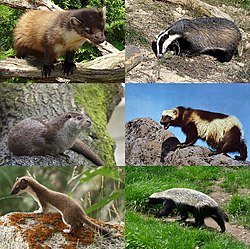
The Mustelidae (;[2] from Latin mustela, weasel) are a family of carnivorous mammals, including weasels, badgers, otters, ferrets, martens, minks and wolverines, among others. Mustelids ([iii]) are a diverse grouping and form the largest family unit in the gild Carnivora, suborder Caniformia. They comprise virtually 66–70 species across nine subfamilies.[four]
Variety [edit]

Mustelids vary profoundly in size and behaviour. The to the lowest degree weasel can be under a foot in length, while the giant otter of Amazonian South America can measure out up to i.vii m (5 ft 7 in) and body of water otters tin can exceed 45 kg (99 lb) in weight. Wolverines can crush bones as thick as the femur of a moose to get at the marrow, and have been seen attempting to drive bears away from their kills. The sea otter uses rocks to break open shellfish to eat. Martens are largely arboreal, while European badgers dig extensive tunnel networks, called setts. Some mustelids have been domesticated; the ferret and the tayra are kept as pets (although the tayra requires a Unsafe Wild Animals licence in the UK), or as working animals for hunting or vermin control. Others accept been important in the fur trade—the mink is oftentimes raised for its fur.
Being one of the nigh species-rich families in the guild Carnivora, the family Mustelidae also is 1 of the oldest. Mustelid-similar forms first appeared about 40 million years ago (Mya), roughly coinciding with the appearance of rodents. The common ancestor of mod mustelids appeared about 18 Mya.[four]
Characteristics [edit]
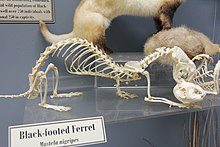
Within a large range of variation, the mustelids exhibit some common characteristics. They are typically pocket-size animals with elongated bodies, short legs, short, round ears, and thick fur.[5] Well-nigh mustelids are solitary, nocturnal animals, and are agile year-round.[six]
With the exception of the body of water otter,[seven] they accept anal smell glands that produce a potent-smelling secretion the animals use for sexual signaling and marking territory.
Most mustelid reproduction involves embryonic diapause.[8] The embryo does not immediately implant in the uterus, merely remains dormant for some fourth dimension. No development takes place as long every bit the embryo remains unattached to the uterine lining. Equally a result, the normal gestation period is extended, sometimes up to a year. This allows the young to be born under favorable environmental conditions. Reproduction has a large energy price, so it is to a female's do good to have available food and mild weather. The immature are more likely to survive if birth occurs after previous offspring have been weaned.
Mustelids are predominantly cannibal, although some eat vegetable matter at times. While non all mustelids share an identical dentition, they all possess teeth adapted for eating mankind, including the presence of shearing carnassials. One feature trait is a meat-shearing upper-back tooth that is rotated 90°, towards the inside of the oral fissure.[9] [10] With variation between species, the nearly common dental formula is 3.1.iii.one 3.1.3.ii .[six]
Ecology [edit]
The fisher, tayra, and martens are partially arboreal, while badgers are fossorial. A number of mustelids take aquatic lifestyles, ranging from semiaquatic minks and river otters to the fully aquatic sea otter, which is one of the few nonprimate mammals known to use tools while foraging. It uses "anvil" stones to crack open the shellfish that form a meaning part of its nutrition. Information technology is a "keystone species", keeping its prey populations in balance and then some do non outcompete the others and destroy the kelp in which they alive.
The black-footed ferret is entirely dependent on some other keystone species, the prairie dog. A family unit of 4 ferrets eats 250 prairie dogs in a year; this requires a stable population of prairie dogs from an area of some 500 acres (2.0 kmtwo).
Nomenclature [edit]
Skunks were formerly included equally a subfamily of the mustelids, but are at present regarded as a separate family (Mephitidae).[eleven] Mongooses bear a striking resemblance to many mustelids, merely belong to a distinctly different suborder—the Feliformia (all those carnivores sharing more contempo origins with the cats) and not the Caniformia (those sharing more contempo origins with the dogs). Because mongooses and mustelids occupy similar ecological niches, convergent development has led to similarity in form and behavior.[ commendation needed ]
Diverseness [edit]
The oldest known mustelid from North America is Corumictis wolsani from the early and tardily Oligocene (early on and late Arikareean, Ar1–Ar3) of Oregon.[1] Eye Oligocene Mustelictis from Europe might be a mustelid, as well.[1] Other early on fossils of the mustelids were dated at the end of the Oligocene to the beginning of the Miocene. Which of these forms are Mustelidae ancestors and which should be considered the showtime mustelids is unclear.[12]
The fossil record indicates that mustelids appeared in the belatedly Oligocene period (33 Mya) in Eurasia and migrated to every continent except Antarctica and Australia (all the continents that were continued during or since the early Miocene). They reached the Americas via the Bering land span.
Human uses [edit]

Several mustelids, including the mink, the sable (a type of marten), and the stoat (ermine), avowal exquisite and valuable furs, so have been hunted since prehistoric times. From the early Middle Ages, the trade in furs was of great economic importance for northern and eastern European nations with large native populations of fur-bearing mustelids, and was a major economical impetus behind Russian expansion into Siberia and French and English expansion in North America. In recent centuries, fur farming, notably of mink, has also become widespread and provides the bulk of the fur brought to market.
One species, the sea mink (Neogale macrodon) of New England and Canada, was driven to extinction by fur trappers. Its advent and habits are almost unknown today because no complete specimens can be establish and no systematic contemporary studies were conducted.
The body of water otter, which has the densest fur of any creature,[13] narrowly escaped the fate of the sea mink. The discovery of big populations in the North Pacific was the major economic driving force behind Russian expansion into Kamchatka, the Aleutian Islands, and Alaska, as well as a crusade for conflict with Nippon and foreign hunters in the Kuril Islands. Together with widespread hunting in California and British Columbia, the species was brought to the brink of extinction until an international moratorium came into effect in 1911.
Today, some mustelids are threatened for other reasons. Sea otters are vulnerable to oil spills and the indirect effects of overfishing; the blackness-footed ferret, a relative of the European polecat, suffers from the loss of American prairie; and wolverine populations are slowly failing because of habitat destruction and persecution. The rare European mink (Mustela lutreola) is ane of the most endangered mustelid species.[14]
One mustelid, the ferret, has been domesticated and is a fairly common pet.
Systematics [edit]
The 68 recent mustelids (67 extant species) are classified into eight subfamilies in 22 genera:[four] [xv]
Subfamily Taxidiinae
Subfamily Mellivorinae
Subfamily Melinae
Subfamily Helictidinae
Subfamily Guloninae [xvi]
Subfamily Ictonychinae [xvi]
| Subfamily Lutrinae (otters)
Subfamily Mustelinae (weasels, ferrets, and mink)
|
Fossil mustelids Extinct genera of the family Mustelidae include:
- Brachypsalis
- Chamitataxus
- Corumictis [one]
- Cyrnaonyx
- Ekorus
- Eomellivora
- Hoplictis [18]
- Megalictis
- Oligobunis
- Plesictis
- Sthenictis
- Teruelictis
- Trochictis [nineteen]
Phylogeny [edit]
Multigene phylogenies constructed by Koepfli et al. (2008)[20] and Constabulary et al. (2018)[iv] constitute that Mustelidae comprises 9 subfamilies. The early mustelids appear to take undergone two rapid bursts of diversification in Eurasia, with the resulting species spreading to other continents only later.[20]
-

Phylogenetic tree of Mustelidae. Contains 53 of the 79 putative mustelid species.[4]
-

Time-calibrated tree of Mustelidae showing divergence times betwixt lineages. Split times include: 28.8 one thousand thousand years (Ma) for mustelids vs. procyonids; 17.8 Ma for Taxidiinae; 15.5 Ma for Mellivorinae; fourteen.viii Ma for Melinae; fourteen.0 Ma for Guloninae + Helictidinae; 11.5 Ma for Guloninae + Naquinae vs. Helictidinae; 12.0 Ma for Ictonychinae; 11.six Ma for Lutrinae vs. Mustelinae.[4]
Mustelid species diversity is often attributed to an adaptive radiation coinciding with the mid-Miocene climate transition. Contrary to expectations, Constabulary et al. (2018)[iv] institute no evidence for rapid bursts of lineage diversification at the origin of the Mustelidae, and farther analyses of lineage diversification rates using molecular and fossil-based methods did not find associations between rates of lineage diversification and mid-Miocene climate transition as previously hypothesized.
Run into also [edit]
- Listing of heaviest extant mustelids
References [edit]
- ^ a b c d Paterson, R.; Samuels, J.X.; Rybczynski, N.; Ryan, M.J.; Maddin, H.C. (2019). "The earliest mustelid in North America". Zoological Periodical of the Linnean Society. 188 (iv): 1318–1339. doi:10.1093/zoolinnean/zlz091.
- ^ "Mustelidae". Merriam-Webster Dictionary.
- ^ "mustelid". Dictionary.com Entire. Dictionary.com.
- ^ a b c d due east f g Law, C. J.; Slater, G. J.; Mehta, R. S. (2018-01-01). "Lineage Diverseness and Size Disparity in Musteloidea: Testing Patterns of Adaptive Radiations Using Molecular and Fossil-Based Methods". Systematic Biological science. 67 (i): 127–144. doi:10.1093/sysbio/syx047. PMID 28472434.
- ^ Constabulary, C. J.; Slater, Thousand. J.; Mehta, R. Southward. (2019). "Shared extremes by ectotherms and endotherms: Body elongation in mustelids is associated with small size and reduced limbs". Evolution. 73 (four): 735–749. doi:10.1111/evo.13702. PMID 30793764.
- ^ a b Rex, Carolyn (1984). Macdonald, D. (ed.). The Encyclopedia of Mammals. New York: Facts on File. pp. 108–109. ISBN978-0-87196-871-5.
- ^ Kenyon, Karl W. (1969). The Sea Otter in the Eastern Pacific Ocean. Washington, D.C.: U.S. Bureau of Sport Fisheries and Wild fauna.
- ^ Amstislavsky, Sergei, and Yulia Ternovskaya. "Reproduction in mustelids." Animal Reproduction Science lx (2000): 571-581.
- ^ Pratt, Philip. "Dentition of the Wolverine". The Wolverine Foundation, Inc. Archived from the original on 27 May 2008. Retrieved one July 2007.
- ^ Taylor, Ken (1994). "Wolverine". Wild animals Notebook Serial. Alaska Department of Fish & Game. Archived from the original on six December 2006. Retrieved 21 Jan 2007.
- ^ Dragoo and Honeycutt; Honeycutt, Rodney L (1997). "Systematics of Mustelid-like Carnivores". Periodical of Mammalogy. 78 (2): 426–443. doi:10.2307/1382896. JSTOR 1382896.
- ^ Wund, Chiliad. (2005). "Mustelidae". Fauna Diversity Web. Academy of Michigan. Retrieved 2020-08-14 .
- ^ Perrin, William F., Wursig, Bernd, and Thewissen, J.Grand.M. Encyclopedia of Marine Mammals, 2nd ed. Bookish Printing; two edition (December 8, 2008). Folio 529. [ane]
- ^ Lodé, Thierry; Cornier, J. P.; Le Jacques, D. (2001). "Refuse in endangered species as an indication of anthropic pressures: the case of European mink Mustela lutreola western population". Environmental Direction. 28 (half-dozen): 727–735. Bibcode:2001EnMan..28..727L. doi:10.1007/s002670010257. PMID 11915962. S2CID 27062634.
- ^ "Explore the Database". www.mammaldiversity.org . Retrieved 2021-06-25 .
- ^ a b Nascimento, F. O. do (2014). "On the right proper name for some subfamilies of Mustelidae (Mammalia, Carnivora)". Papéis Avulsos de Zoologia (São Paulo). 54 (21): 307–313. doi:10.1590/0031-1049.2014.54.21.
- ^ Patterson, Bruce D.; Ramírez-Chaves, Héctor E.; Vilela, Júlio F.; Soares, André East. R.; Grewe, Felix (2021). "On the classification of the American clade of weasels (Carnivora: Mustelidae)". Periodical of Animal Diverseness. 3 (two). doi:x.29252/JAD.2021.3.2.1 (inactive 31 October 2021). ISSN 2676-685X.
{{cite journal}}: CS1 maint: DOI inactive every bit of October 2021 (link) - ^ Valenciano, A.; Jiangzuo, Q.; et al. (March 2019). "First Record of Hoplictis (Carnivora, Mustelidae) in East Asia from the Miocene of the Ulungur River Area, Xinjiang, Northwest People's republic of china". Acta Geologica Sinica. 93 (two): 251–264. doi:10.1111/1755-6724.13820. S2CID 133900941.
- ^ Morlo, M.; LeMaitre, A.; et al. (Nov 2019). "First tape of the mustelid Trochictis (Carnivora, Mammalia) from the early on Late Miocene (MN 9/x) of Federal republic of germany and a re-appraisal of the genus Trochictis". Historical Biology. 33 (8): 1183–1195. doi:10.1080/08912963.2019.1683172. S2CID 209607263.
- ^ a b Koepfli, Klaus-Peter; Deere, K.A.; Slater, G.J.; Begg, C.; Begg, K.; Grassman, L.; Lucherini, M.; Veron, G.; Wayne, R.K. (February 2008). "Multigene phylogeny of the Mustelidae: Resolving relationships, tempo and biogeographic history of a mammalian adaptive radiation". BMC Biological science. six: 10. doi:10.1186/1741-7007-6-10. PMC2276185. PMID 18275614.
Further reading [edit]
- Whitaker, John O. (1980-ten-12). The Audubon Society Field Guide to N American Mammals . Alfred A. Knopf. p. 745. ISBN978-0-394-50762-0.
External links [edit]
 | Wikimedia Commons has media related to Mustelidae. |
- "The Mighty Weasel" February 19, 2020 Nature
porterhiscitifted.blogspot.com
Source: https://en.wikipedia.org/wiki/Mustelidae
Belum ada Komentar untuk "Match the Marine Mammal With Its Appropriate Classification Family Mustelidea"
Posting Komentar